Thursday, 27 February 2020

Google Recommends Hiring SEOs in New ‘Search for Beginners’ Video

Google’s latest episode of “Search for Beginners” covers the top 5 things people should consider for their websites. We think Google saved the best for last because the fifth item on the list involves hiring an SEO.

Videos in the “Search for Beginners” series have been full of DIY tips up to this point, so it’s nice to see Google emphasize the benefits of hiring a professional SEO.

In fact, future videos in the “Search for Beginners” series will dive deeper into the topic of hiring SEOs. Here’s exactly what is stated in Google’s most recent video:

“Are you looking for someone to work on [your website] on your behalf? Hiring a search engine optimizer, or “SEO,” might be an option. SEOs are professionals who can help improve the visibility and ranking of your website. We’ll talk more about hiring an SEO in future episodes.”

Other Website Considerations for Beginners

For those interested, here is the complete list of Google’s top 5 website considerations for people who are new to SEO.

  1. Check if your site is indexed: Perform a search for “site:your-website.com” to see if it’s indexed in Google Search.
  2. Provide high quality content: Follow the advice in Google’s official webmaster guidelines and best practices documents.
  3. Ensure website is fast and accessible on all devices: Visit g.co/mobilefriendly to test mobile-friendliness.
  4. Ensure website is safe for visitors: Secure your website with a HTTPS connection.
  5. Hire an SEO: Covered above.

See the full video below:

The post Google Recommends Hiring SEOs in New ‘Search for Beginners’ Video appeared first on AdInfusion.


source https://www.adinfusion.com/google-recommends-hiring-seos-in-new-search-for-beginners-video/

Tuesday, 25 February 2020

Mozilla Rolls Out Encrypted Browsing by Default for U.S. Firefox Users

Marketers have relied on third-party tracking cookies for the last 25 years to track consumer behavior online. Nearly all ad tech and martech platforms use cookies for targeting, retargeting, display advertising and behavioral marketing in general. Now, that’s all changing.

Today, Mozilla is flipping on the switch to turn on encrypted DNS over HTTPS for U.S. users by default. If you’re unfamiliar with the tech, the pitch is this feature will help prevent internet service providers from tracking the sites you go to.

DNS over HTTPS (DoH) is meant to address the inherent privacy vulnerabilities in how you surf the web. The Domain Name Service (DNS) is, in Mozilla’s words, “one of the oldest parts of internet architecture” and one that hasn’t seen a lot of changes in the past 30 years. This plays into tracking because when you go to a URL, your browser needs to look up the site’s corresponding IP address. It does that via the DNS. But, even if the site you’re visiting is encrypted via HTTPS, the DNS lookup is done over plain text. That means ISPs—or other entities—can, if they so choose, easily figure out what websites you’ve gone to and build up a profile of your browsing habits. DoH is meant to circumvent that by ensuring the DNS lookup is also encrypted. It won’t necessarily stop tracking wholesale, but it will make it more difficult.

Ready or not, the cookie crackdown is in full effect. The cumulative effect of Intelligent Tracking Prevention (ITP) on Safari, Enhanced Tracking Protection (ETP) on Firefox, and more granular third-party cookie blocking on Chrome are making measuring digital marketing activities increasingly difficult.

That’s not to say that it’s the end of measurement, but things are going to be different from now on. The reality is that marketers need to completely rethink how to use testing frameworks for measuring marketing value.

While it seems pretty scary right now, keep in mind that cookies are a 25-year-old technology and we’ll definitely find a way to move on. It’s going to be all about exploring new technologies, innovation, and striking a balance between profit and privacy choices to avoid another wave of consumer backlash. Taking advantage of first-party data that you get when people intentionally engage with your brand is the first step toward accomplishing this.

The post Mozilla Rolls Out Encrypted Browsing by Default for U.S. Firefox Users appeared first on AdInfusion.


source https://www.adinfusion.com/mozilla-rolls-out-encrypted-browsing-by-default-for-u-s-firefox-users/

Thursday, 20 February 2020

Google used AI and human moderation to purge over 75 million Google Maps reviews

Hundreds of millions of people contribute over 20 million reviews, ratings, and other pieces of content to Google Maps’ over 200 million points of interest daily — it’s how the platform continues to grow so rapidly. But user contributions are intrinsically fraught. That’s why increasingly, Google is using AI and machine learning to spot malicious contributions at submission time, ensuring they don’t reach the over 1 billion users who regularly use Maps.

In a blog post, Google said that it uses automated detection systems, including machine learning models, to scan millions of contributions to detect and remove policy-violating content. In the case of reviews, its systems audit every review before they’re published to Maps, looking for signs of fake or misleading content. And its machine learning models watch for specific words and phrases and examine patterns in the types of content an account has contributed in the past, while taking into account suspicious review patterns

Of course, AI isn’t perfect, which is why Google employs teams of trained operators and analysts who audit reviews, photos, business profiles, and other types of content, both individually and in bulk. In 2019 alone, with the aid of machine learning systems that improved in their ability to block policy-violating content and detect anomalies for manual review, human moderators removed more than 75 million policy-violating reviews and 4 million fake business profiles. They also took down more than 580,000 reviews and 258,000 business profiles that were reported directly to Google, and they reviewed and removed more than 10 million photos and 3 million videos that violated Maps’ policies and disabled more than 475,000 user accounts.

“The vast majority of contributions made to Maps are authentic, with policy-violating content seen less than one percent of the time. And we’ll continue to develop new tools and techniques to fight against bad actors,” said Maps director of product Kevin Reece. “Contributed content is an indispensable part of how we’re making Maps richer and more helpful for everyone.”

The metrics update comes after a Wall Street Journal report concluded that there are millions of fake listings on Maps, which have since been removed by Maps’ moderation team. In response to this and other controversies relating to user-submitted content, including an incident involving a drawing of an Android logo urinating on an Apple logo, Google has at various points shuttered public map editing tools and introduced new Maps moderation features.

This purge highlights an important point to anyone thinking of trying to manipulate their reviews to look better to new customers. If your ordinary business practices are such that you are regularly generating negative reviews, then any attempt at growing your business will in turn just generate negative reviews. That’s why it’s better to address the underlying problem than try and cover it up with fake reviews. Besides, it would sure suck to put a lot of work into securing a bunch of fake reviews only to wake up one morning to see them all wiped out by Google’s AI.

The post Google used AI and human moderation to purge over 75 million Google Maps reviews appeared first on AdInfusion.


source https://www.adinfusion.com/google-used-ai-and-human-moderation-to-purge-over-75-million-google-maps-reviews/

Friday, 14 February 2020

Google ordered to reveal the author of Australian dentist’s bad review

An Australian court has ordered Google to identify the person behind an anonymous bad review of a dentist.

Dr Matthew Kabbabe, a teeth-whitening specialist in Melbourne, sought the order so he could sue for defamation.

He claimed user CBsm 23 had damaged his business by telling others to “STAY AWAY” from a procedure criticized as “extremely awkward and uncomfortable”.

The ruling forces the hand of the tech giant, which has previously defended allowing negative reviews on its site.

Under the order, Google will be required to pass to Dr Kabbabe any personal details such as any names, phone numbers, location metadata and IP addresses linked to the account.

International law allows for people to seek documents from overseas parties that they need for their case.

‘Groundbreaking’ case

Google had previously rejected the dentist’s requests for the review to be removed or to share information about its author.

According to his affidavit, Google had told Dr Kabbabe: “[W]e do not have any means to investigate where and when the ID was created.”

However, Justice Bernard Murphy ruled that Dr Kabbabe had grounds to pursue a defamation case and that Google was “likely to have or have had control of a document or thing that would help ascertain that description of the prospective respondent”.

Mr Kabbabe’s lawyer described the ruling as a “groundbreaking” win for small businesses and argued Google had a duty of care in providing a platform for potentially defamatory postings.

“If you’re out there trying to hide by anonymity, even via VPN, I think the court system’s catching up now and there are ways and means of obtaining that information,” Mark Stanarevic told the Australian Broadcasting Corporation.

Google is yet to reply to queries about the ruling. The firm has previously been reluctant to remove bad reviews but has done so in several instances following court orders.

Last year, it told Australian law reform experts that defamation cases over online reviews could lead to the suppression of consumer rights and free speech.

The post Google ordered to reveal the author of Australian dentist’s bad review appeared first on AdInfusion.


source https://www.adinfusion.com/google-ordered-to-reveal-the-author-of-australian-dentists-bad-review/

Thursday, 30 January 2020

Google Searches For Corona Beer Surge As News Of Coronavirus Outbreak Spreads

The coronavirus outbreak that originated in Wuhan, China, has nothing to do with Corona beer, but some people seem to think it does.

s the outbreak spread last week, searches for “corona beer virus,” “beer virus,” and “beer coronavirus” increased substantially worldwide, according to Google Trends.

Searches for “corona beer virus” jumped 2,300 percent globally from January 18 to January 26, Business Insider reported. Searches for “beer virus” jumped 744 percent and searches for “beer coronavirus” jumped 3,233 percent.

The post Google Searches For Corona Beer Surge As News Of Coronavirus Outbreak Spreads appeared first on AdInfusion.


source https://www.adinfusion.com/google-searches-for-corona-beer-surge-as-news-of-coronavirus-outbreak-spreads/

Monday, 16 December 2019

How to Beat Google Bedlam Update

Google Bedlam Recovery Plan:

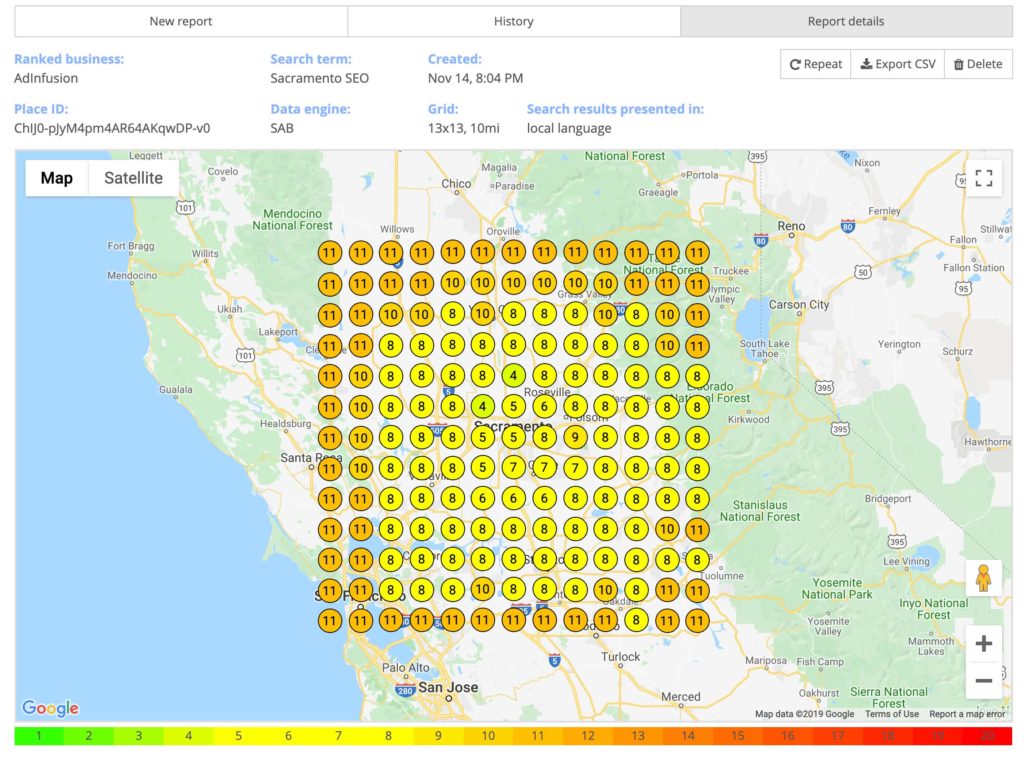
We’ve been receiving a lot of questions lately about the latest Google algorithm update known as “Bedlam.” The Bedlam update (also called “Possum 2.0”) rolled out in early November 2019 – which has now been completed globally. According to Google Search Liaison, this update involved prioritizing neural matching in an attempt to provide local searchers with more relevant results.

So this update has Google trying to do a better job of figuring out what a business is all about. That’s why I think GMB posts are such a good way to help (hint hint…)

Google Confirms Bedlam Update Based on Neural Matching

On Monday, December 2, Google confirmed it had rolled out an update based on neural matching – an AI method used to better connect words with concepts. Before this, the smart money was betting on relevancy, not proximity ( so add another reason why we’re supporting bedlam over “Possum 2.0 )

Ok But Can Someone Please Explain WTF is Neural Matching

Some key factors to know based on more of Danny Sullivan’s tweets:

(thanks SEMRush )

Actionable Insights

I kept seeing the same advice given over and over about not changing anything and just waiting this out, but given the amount of traffic I personally lost from this update I went to work testing solutions based on things I was seeing that showed a positive impact on local rankings :

  • keywords in GMB names
    Still seeing a lot of this in several SERPS and if you can match your sitename/brand to the GMB this may work for you – many might frown upon it but it’s still recognized as a ranking influencer
  •  Optimizing GMB Description
    Ensure the GMB description is keyword optimized using search terms and phrases prospective customers would use when looking for a particular product or service
  • GMB posts containing relevant keywords
    I believe this one is super important. I’ve definitely increased my Google My Business postings and focused on posting and (and reposting!) content on my site that’s directly relevant to the categories I lost rankings for in November.

I do not think this is related to citations because I spent almost zero time on getting new citations (I was already way ahead of my competitors when it came to that) I also checked with friends who tested “map embeds” and they didn’t see a positive impact from that either so i think that it’s a waste of time & money. I have, however, seen some good improvements on sites that we stacked authority from other Google properties, but my tests didn’t directly coincide with the stuff that happened in November so it would be hard to say for sure this helped with that, but I don’t think it hurts 😉

How Bad Were Things When Bedlam Hit

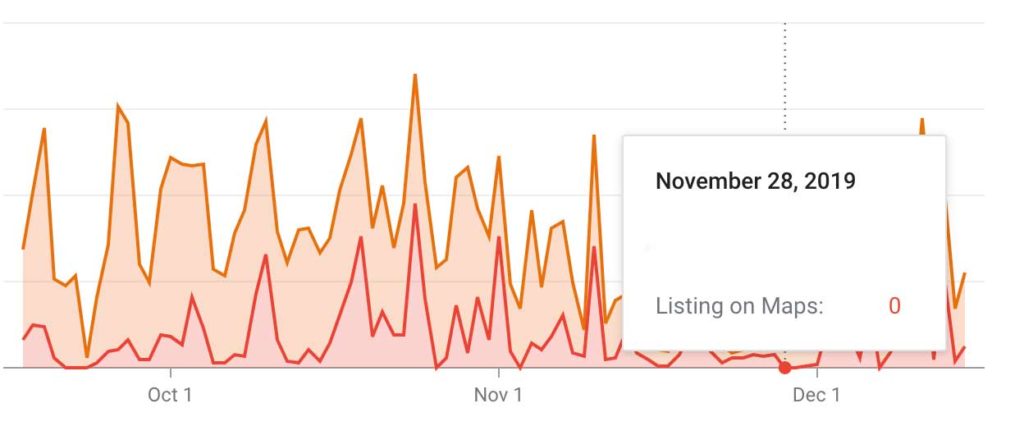
If you didn’t get a chance to read my first post about Google Bedlam last month, you might be surprised to learn it got a little worse.

by the end of November the traffic from my GMB listing had pretty much completely dried up
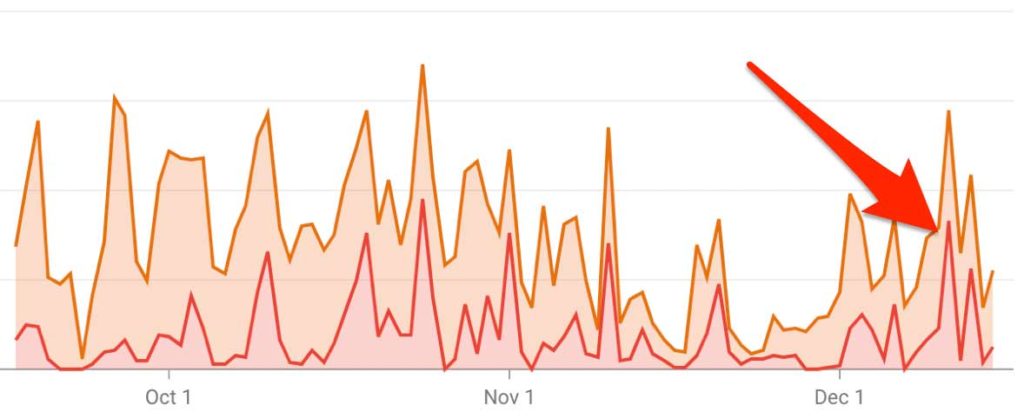
Within the last few weeks, I’ve had traffic spike back up to pre-Bedlam numbers. I think there’s definitely a snowball effect with GMB posting, and it takes time to build momentum and views going when you start up posting.

Final Thoughts on Optimizing for Google Bedlam

Algorithm updates can be nerve-racking if they hit your Google My Business listing. Keep in mind that you should never make rash changes to your digital marketing strategy because of an update. Diversification is Key! You must diversify both your SEO and online marketing tactics. You wouldn’t invest all your money in one stock would you? Then don’t put all your online marketing eggs in one basket either. Be engaged in a social media platform, maintaining a PPC campaign, participating in forums for your industry, broadening your influence and reach by writing some kick-ass guest blogs, etc. Your diversification possibilities are far and wide.

If you’re reading this you were hit by Bedlam and still haven’t figured it out, reach out to me and I’ll audit your site and give you a list of customized improvements. If you’re familiar with this update and disagree with what I’ve said here – I’d actually love to hear conflicting opinions more than hollow agreements – that helps us all learn more so leave a comment below with your thoughts!

The post How to Beat Google Bedlam Update appeared first on AdInfusion.


source https://www.adinfusion.com/how-to-beat-google-bedlam-update/